
The Montessori method
Learning that follows the child.
Children learn better through self-discovery and the freedom to choose. The Montessori Method helps to promote creativity, critical thinking, and leadership skills, with a teacher close by to observe and guide rather than direct.
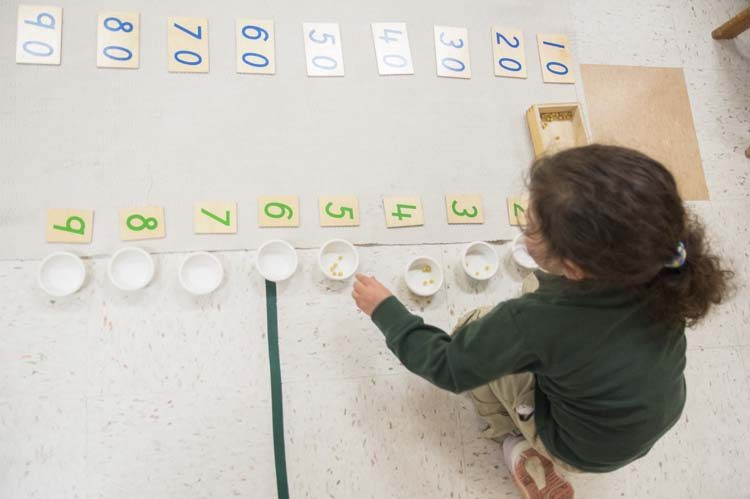 Work the child chooses
One test of the correctness of educational procedure is the happiness of the child.
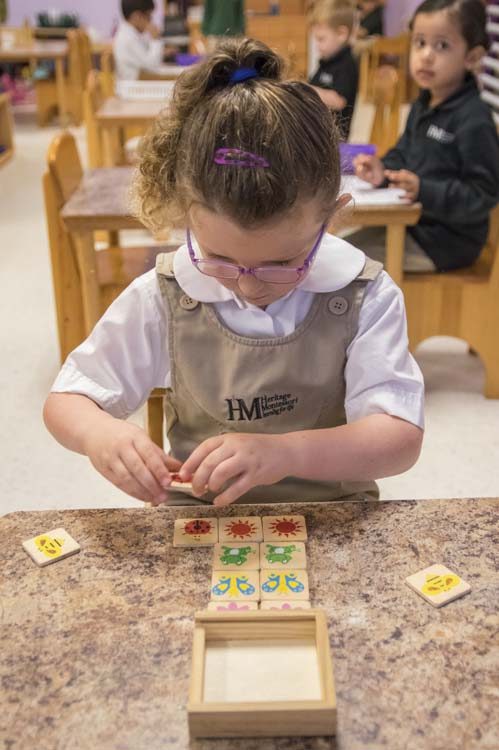 One of the lessons
Where it began
A method born from watching children.
Maria Montessori visited orphanages in Rome, where she observed children in their natural state of learning. Her focus was to uncover the secrets of childhood learning and to identify the key elements tied to positive learning.
In 1906 she was invited to oversee the care and education of children of working parents in the San Lorenzo district of Rome. She opened her first school, enrolling fifty or sixty children. Given free choice of activity, they showed more interest in practical work and in her materials than in the toys provided for them.
She came to believe that acknowledging each child as an individual, and treating them as such, would yield better learning. She began to see independence as the aim of education, and the role of the teacher as an observer and director of a child's natural development. Several variations have been added over time, but the tenets of her method have remained.
Five ideas behind every room.
They shape how the room is set up, how a teacher speaks, and what a child is free to do all day.
Child-led choice
A child is more motivated to learn when working on something of their own choosing. They pick the work, within the materials a teacher has prepared, and stay with it as long as it holds them.
The prepared environment
Every material sits within reach and has a clear purpose. Children are free to choose, work uninterrupted, and move within the limits set by the room.
Independence as the aim
We help a child do it themselves, not do it for them. Pouring, buttoning, and putting work back build real confidence.
Multi-age classrooms
Classes hold a well-balanced division of ages, so the little ones learn by watching and the older ones learn by helping.
The teacher observes
The teacher's role is to observe each child and provide safety, comfort, guidance, strength, and coaching, offering the right material at the right moment.
The room does half the teaching.
A Montessori room is calm and ordered on purpose. Shelves sit low. Real tools, not plastic toys, wait in trays a child can carry. There is one of most things, so a child learns to wait, to share, and to put work back the way they found it.
When a room is right, the teacher steps back. The child sees the work, reaches it, and begins.
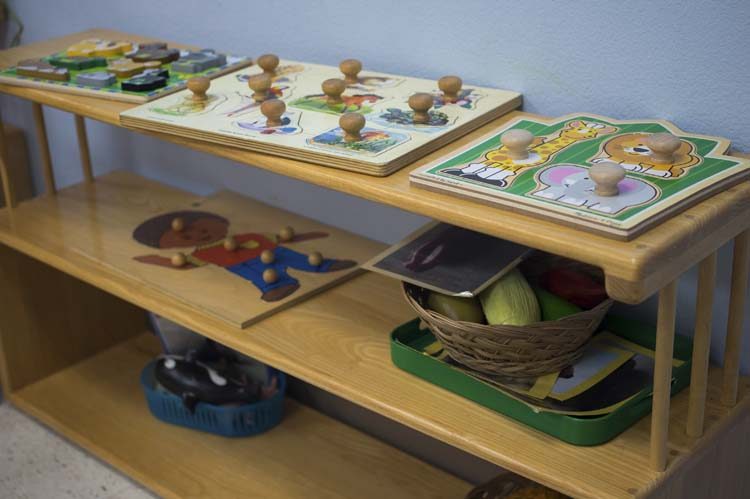 Set out for little hands
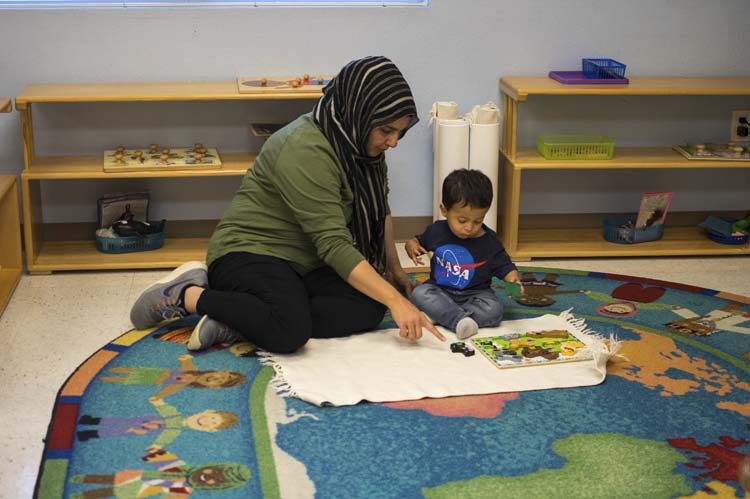 Showing a new lesson
A guide, not a lecturer.
In Montessori tradition the lead teacher is called the directress. She observes each child closely and provides materials and activities that advance learning by building on what a child has already gained. This gentle guidance helps a child master the challenge at hand.
Each class may have one non-teaching assistant who supports the directress by making materials, supervising outdoor activities, and helping with field trips, or what Montessori called going-out. The child stays at the center the whole time.
Benefits of the method
What the method does for a child.
- Fosters a lifelong love of learning
- Allows children to work at their own pace, free of pressure and competition
- Optimizes learning by recognizing and using appropriate learning styles
- Engages all the modalities: kinesthetic, visual, and auditory
- Serves the development of the whole child: academic, social, emotional, and spiritual
- Classifies groups by stages of development, allowing multi-ages and ample social development
Questions and answers
The questions parents ask most.
How can children learn if they are free to do whatever they want?
Dr. Montessori observed that children are more motivated to learn when working on something of their own choosing. A Montessori student may choose his focus of learning on any given day, but his decision is limited by the materials and activities in each area of the curriculum that his teacher has prepared and presented to him.
If children work at their own pace, don't they fall behind?
Although students are free to work at their own pace, they are not going it alone. The Montessori teacher closely observes each child and provides materials and activities that advance his learning by building on skills and knowledge already gained. This gentle guidance helps him master the challenge at hand and protects him from moving on before he is ready, which is what actually causes children to fall behind.
Do Montessori teachers follow a curriculum?
Montessori schools teach the same basic skills as traditional schools, and offer a rigorous academic program. Most of the subject areas are familiar, such as math, science, history, geography, and language, but they are presented through an integrated approach that brings separate strands of the curriculum together.
Why don't Montessori teachers give grades?
Grades, like other external rewards, have little lasting effect on a child's efforts or achievements. The Montessori approach nurtures the motivation that comes from within, kindling the child's natural desire to learn.
The teacher's role is to observe each individual child and provide safety, comfort, guidance, strength and coaching.
The best way to understand it is to see it.
Walk the classrooms, meet a teacher, and watch the children at work. Ask anything. Tuition is shared when you visit.